
Every Fire Emblem player has a story about a unit that got cheated by the game. The Paladin who barely grew Strength across twenty levels. The mage who capped every stat except the one that mattered. The cavalier that was supposed to carry the endgame and arrived there mediocre.
These stories exist because of one mechanic: growth rates. A simple system (a percentage, a dice roll, a +1 or nothing) that has driven more emotional investment, more session resets, and more community debate than almost any other mechanic in the strategy RPG genre.
This is an analysis of how that system works, why it creates the outcomes it does, and whether any of it constitutes good design.
1. The Growth Rate System
Fire Emblem assigns each character a set of growth rates, one percentage value per stat. At every level-up, the game rolls against each of those percentages independently. If the roll succeeds, the stat increases by one. If it fails, nothing happens.
A unit with 60% Strength growth has a 60% chance to gain +1 Strength per level. A unit with 20% Resistance growth will almost never see that stat move. The values are fixed per character. They don't change with class, time, or player decisions (in most entries).
- Growth rates typically range from 5% to 85% depending on the unit and stat.
- Each stat rolls independently. A good Strength roll says nothing about Speed.
- The system has been in every mainline entry since Fire Emblem: Shadow Dragon (1990).
- Players can often view growth rates in-game or through community wikis.
It's a remarkably minimal mechanic. There's no formula to learn, no secondary system, no player skill involved. Just probability, applied once per stat per level, forever.
2. The Roll: Probability vs. Perception
The implementation is even simpler than it sounds: the game generates a random integer between 0 and 99 for each stat. If the result is less than the growth rate, the stat goes up. That's the entire mechanic.
Simple. Almost insultingly simple.
But the way players perceive this is where it gets interesting. A 60% growth rate feels like a guarantee. When a unit doesn't gain that stat for three consecutive levels, it feels like a betrayal, because three consecutive failures at 60% has only a 6.4% probability. It's rare. But in a campaign with fifteen or more characters each leveling up a dozen times, rare events happen constantly.
The probability of missing a 60% growth three times in a row is (0.4)³ = 6.4%. Unlikely for a single unit, but across an entire cast over a full campaign, events at this rarity are nearly guaranteed to occur somewhere.
Players systematically misread these probabilities. High growth rates feel deterministic until they fail. Low growth rates feel like curses even when they occasionally pay off. The randomness is invisible when it goes well and glaring when it doesn't, which is how variance always works, but Fire Emblem makes it especially legible through its level-up screen.
3. The Level-Up Screen: A Parade of Failure
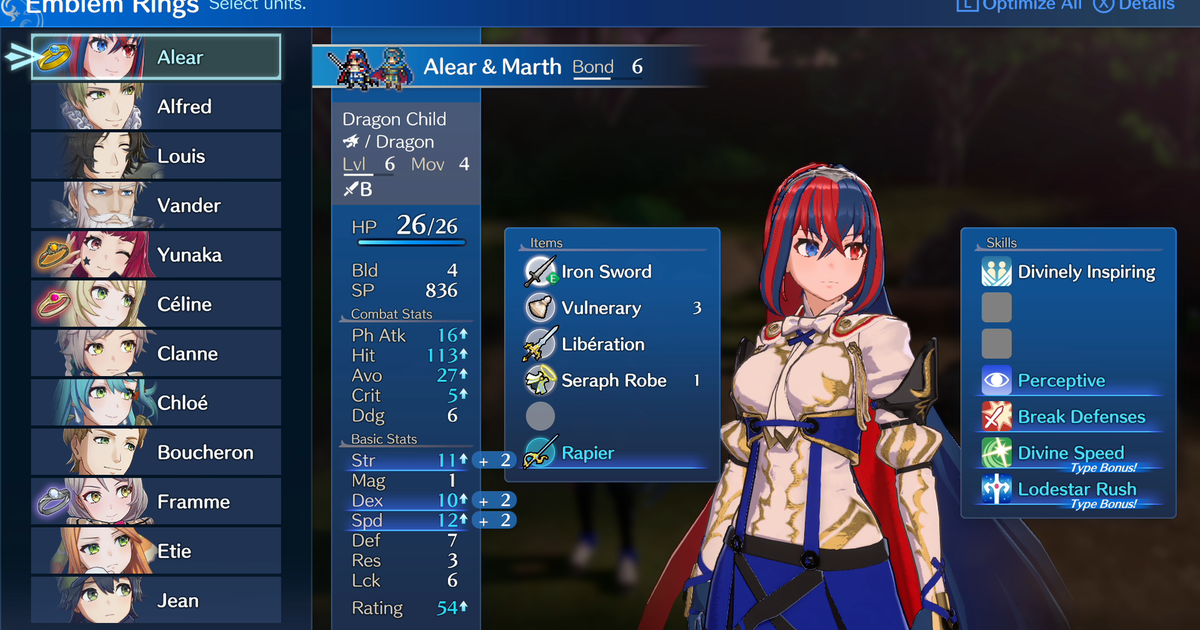
Most RPGs don't show you what you didn't get. Fire Emblem does. The level-up screen displays every stat simultaneously, lighting up the ones that increased and leaving the rest visually present, dim, unchanged, a reminder of what the roll didn't give you.
This is a deliberate design choice, and its consequences are enormous. A level where a unit gains two stats feels mediocre when five others stay dark. A level where only Speed increases (every Fire Emblem player has seen this) becomes its own kind of joke. The community even has a term for it: a "blessed" or "cursed" unit, depending on whether the variance broke good or bad.
Every Fire Emblem player, at least onceAll that, and she only got Speed.
The screen turns each level-up into a judgement. You see exactly how much the game gave you and exactly what it withheld. Over twenty-plus levels, this accumulates into a character arc entirely authored by probability, but one that players experience as deeply personal.
4. Brutal Variance and the "Stat Screwed" Unit
Let's be precise about the variance. Consider a unit with consistent 50% growth rates across eight stats, leveling up twenty times. The expected total gains are 80 points distributed across those stats, 10 per stat on average. The standard deviation on a single stat over 20 levels is √(20 × 0.5 × 0.5) ≈ 2.2.
That means landing at 6 gains instead of 10 in a single stat (four below average) is within two standard deviations. Unusual but plausible. For a key combat stat like Strength or Speed, that gap can mean the difference between a unit that doubles enemies and one that doesn't.
In Fire Emblem, doubling an enemy requires 5+ more Speed than the target. A unit that falls 4 points short of their expected Speed growth may permanently lose the ability to double entire enemy classes, a significant loss of combat utility that no amount of skill can compensate for.
The community calls these "stat screwed" units, and the phenomenon is real. A unit built around high Strength growth who lands in the bottom quartile of their distribution is genuinely weaker, not by player error, but by probability. The game's difficulty isn't adjusted to account for this. The player absorbs the variance.
5. RNG Abuse and the Reset Loop
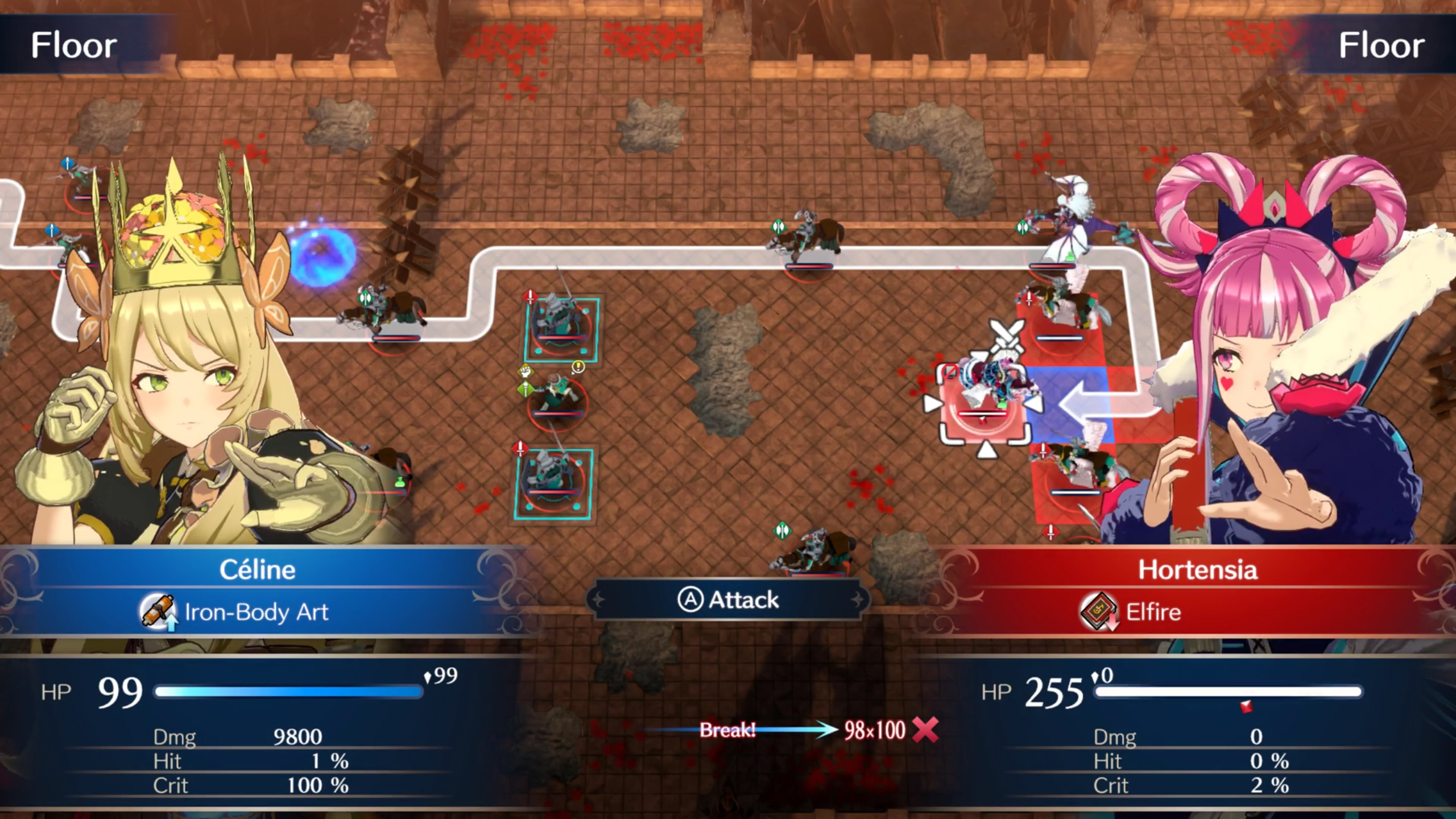
When variance hurts badly enough, players reset. This is universal in games with save mechanics, but Fire Emblem is one of the few franchises where growth rate manipulation is a documented, community-accepted practice with its own name: RNG abuse.
The technique is straightforward. Save before a level-up. Check the result. If the gains are poor, reset and try again. On emulators with save states this takes seconds. On original hardware it required resetting the console and reloading a save, sometimes from several minutes earlier. Players did it anyway.
What drives this behavior isn't just a desire to win. It's something more specific: the belief that a unit should be strong, and that the random outcome is an injustice the player can correct. The mechanic generates enough attachment that players fight the dice rather than accept them.
In older Fire Emblem titles the RNG seed advanced based on frame timing and player inputs, meaning a reset with slightly different timing would produce a different result. Players learned to introduce small delays to manipulate seeds, turning a probabilistic system into a deterministic one through careful execution.
The reset loop is a coping mechanism for poor statistical outcomes. But it's also evidence that the system generates enough attachment for players to invest significant time fighting it. No one resets for a unit they don't care about.
6. Alternative Systems: What Happens Without the Variance
More recent entries in the series have experimented with reducing or eliminating this variance, and the community's response is instructive.
Fire Emblem Engage (2023) introduced a Fixed Mode option that replaces random rolls with guaranteed growth thresholds. If a growth rate is 60%, the character accumulates 0.6 points per level and gains +1 every time that accumulator crosses a whole number. No surprises, no bad runs. Just the expected value, delivered reliably.
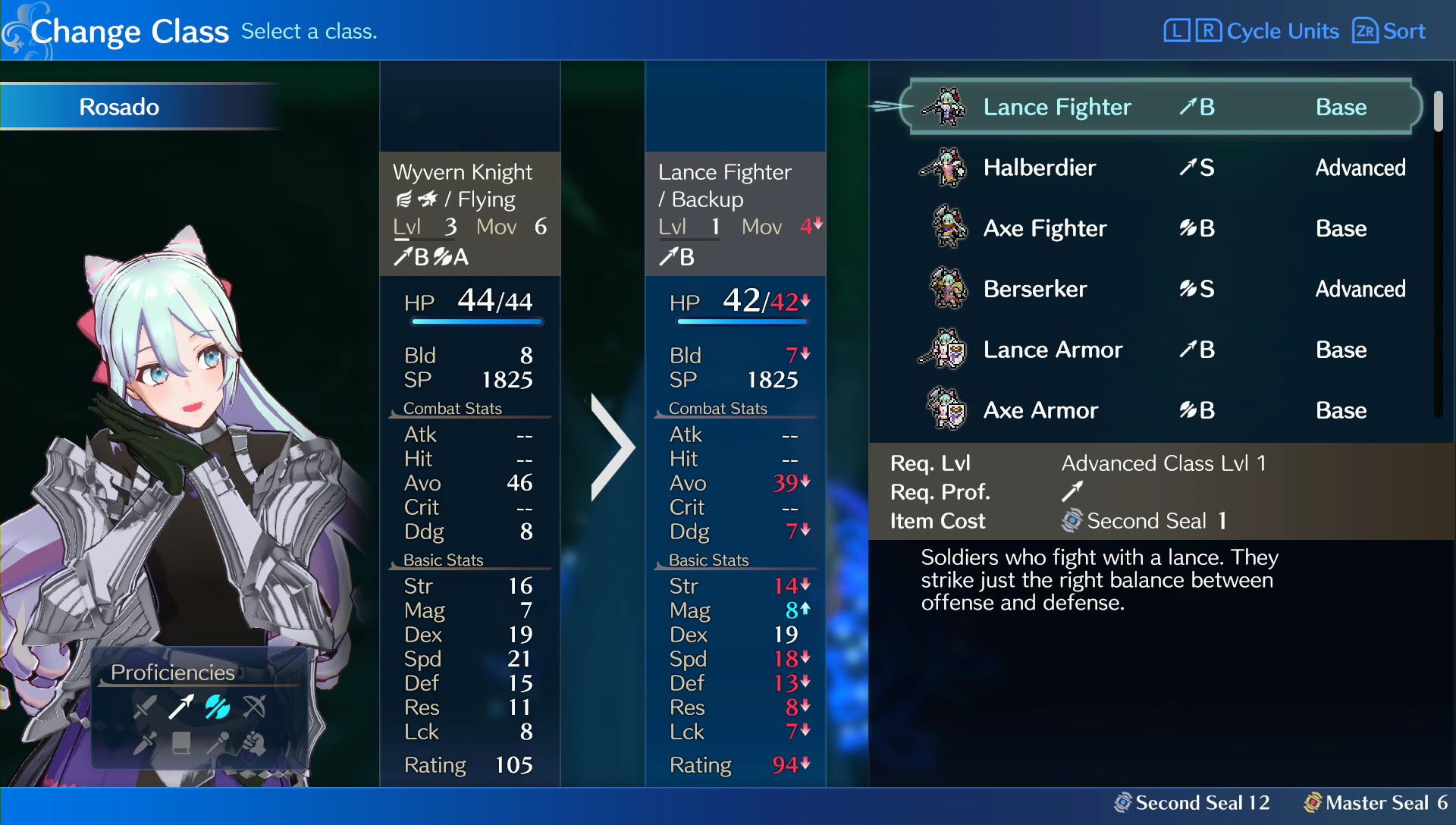
Fire Emblem: Three Houses (2019) partially addresses variance through class-based stat caps and the monastery system, which lets players shape units through instruction. The randomness is still there, but it's cushioned by enough additional levers that a poor run of levels feels recoverable.
- Fixed Mode (Engage): deterministic growth, loved by competitive players and min-maxers.
- Monastery teaching (Three Houses): supplements growth rates with deliberate stat investment.
- Class reclassing systems: redirect growth rates by changing class, giving players more agency.
- Pair Up and support bonuses: partially compensate for stat deficits through external buffs.
Competitive players and min-maxers tend to prefer Fixed Mode. Casual players often don't. The reason is revealing: removing variance also removes the narrative. Fixed growth units don't have stories. They level exactly as predicted, arrive at exactly the expected stats, and perform exactly as designed. They work, but they're not yours.
7. Is It Good Design?
By conventional standards, growth rates are a deeply flawed mechanic. They create unfair variance, can render units permanently weaker through no fault of the player, and actively incentivize save-scumming that circumvents the game's intended risk structure. A system that encourages players to fight against its own outputs is usually considered broken.
And yet Fire Emblem has run this system for over thirty years across over a dozen mainline entries. It survived westernization, multiple visual overhauls, and the franchise's shift from niche import to mainstream JRPG staple. That staying power demands an explanation.
The explanation is the emotional side effect: variance creates uniqueness. Your Hector and my Hector are not the same Hector. The Seth who became an absolute wall of Defense because the dice cooperated for eight straight levels is yours. You were there, you saw it happen, it felt earned even though it wasn't. That ownership is real, even if its source is probabilistic noise.
The randomness isn't the feature. The attachment it generates is.
This is the illusion of tactical depth. The game feels more strategic than it is, partly because players made real decisions (which units to field, who to invest in, when to take risks in combat) and those decisions intersected with variance to produce outcomes that feel authored. The character feels built. Even when it was mostly luck. Even when the player's decisions were secondary to the dice.
Conclusions
Fire Emblem's growth rate system is a mechanically bad system that works beautifully in practice. It produces unfair outcomes, rewards save manipulation, and creates permanent unit quality gaps that no player skill can fully compensate for. By formal game design metrics, it should have been phased out decades ago.
But what it generates in exchange (emotional ownership, narrative uniqueness, the sense that a run is genuinely yours) is worth more than mechanical fairness. Players don't just play Fire Emblem. They remember their units. They have opinions about them. They argue about whether the unit got cheated or got lucky. A deterministic system can't produce any of that.
The real lesson isn't that variance is good design. It's that the meaning players attach to randomness can generate engagement that no deterministic system quite replicates. The growth rate roll is almost nothing (a percentage and a random integer) and out of it grows an entire relationship between player and character.
That's either a remarkable accident or a very clever design. After thirty years, it's hard to tell which, and maybe that ambiguity is the point.

